A physicist who cares about the future of humanity, and AI

Nobel laureate Yang Chen-Ning, whom I personally think was one of the greatest Chinese ever lived, famously said in 1980, when asked about his opinion on the next ten years of high-energy physics: “In the next ten years, the most important discovery in high-energy physics is that ‘the party’s over.’ ”

He was right, of course. The symmetry-breaking euphoria of the ’70s gave way to the long winter of null results. The accelerators grew, the budgets swelled, but the surprises stopped coming. It was as if nature herself had pulled down the blinds and whispered, enough for now.

But perhaps the party did not end—it merely changed venue. While physicists mourned the silence of their colliders, another kind of machinery began humming quietly in the background. Not cyclotrons or bubble chambers this time, but GPUs. Not hunting for particles, but for patterns.

Today, AI researchers train networks deeper than any potential well, and tune loss landscapes as delicate as Feynman’s integrals. They, too, speak of symmetry, invariance, duality—only now these symmetries live not in spacetime but in data. The tensor, once a tool for fields and curvatures, now describes thoughts and pixels.

Some old physicists scoff: “You’ve mistaken computation for comprehension.” Yet one suspects that if nature had a sense of humor, she would find this fitting—that intelligence itself became the next frontier of physics. After all, what is learning but the renormalization of information? What is consciousness but the universe performing gradient descent on itself?

So perhaps the party was never over—it simply moved from the laboratories of matter to the laboratories of mind. And if we listen closely to the soft whirr of cooling fans in a data center, we might just hear the echo of the same music that once played at CERN: the sound of curiosity, endlessly trying to model the infinite.
Current Focus

  • Mathematical foundation of deep neural networks
  • AI Safety and ethics
  • Systematic prevention of AI abuse

Research Highlights

Selected publications with brief context notes.

arXiv · 2025

Position: Many generalization measures for deep learning are fragile

Argues that post-hoc generalization diagnostics can be destabilized by minor training tweaks, cataloguing failure modes and outlining practices needed to make these measures trustworthy in modern deep learning pipelines.

Read Preprint →
arXiv · 2025

Closed-form ℓr norm scaling with data for overparameterized linear regression

Derives unified high-probability scaling laws for the ℓr norms of minimum-ℓp interpolators under Gaussian design, exposing how implicit bias governs generalization across overparameterized linear models and diagonal networks.

Read Preprint →
arXiv · 2021

Why flatness does and does not correlate with generalization for deep neural networks

Dissects popular flatness-based generalization heuristics, showing how simple parameter rescaling can break them while clarifying when flat minima still provide reliable signals for model performance.

Read Preprint →
RSC Advances · 2019

First-principles study of the layered thermoelectric material TiNBr

Uses density-functional calculations to reveal TiNBr’s ultrahigh Seebeck response, low lattice thermal conductivity, and strong phonon anharmonicity, highlighting layered metal nitride halides as promising thermoelectrics.

Read Publication →
JACS · 2017

Synergistic Coupling between Li6.75La3Zr1.75Ta0.25O12 and Poly(vinylidene fluoride)

Demonstrates a garnet–polymer composite solid electrolyte where coupling Li6.75La3Zr1.75Ta0.25O12 with PVDF unlocks high ionic conductivity alongside strong mechanical and thermal stability for safer solid-state batteries.

Read Publication →

What's New

Recent snapshots from work, and beyond.

My DPhil thesis is now online

The final Oxford DPhil thesis is now published and ready to download. Download the thesis (PDF) and feel free to share with colleagues or students.

If you spot a typo or want to discuss any of the results, send me a note—always happy to talk shop.

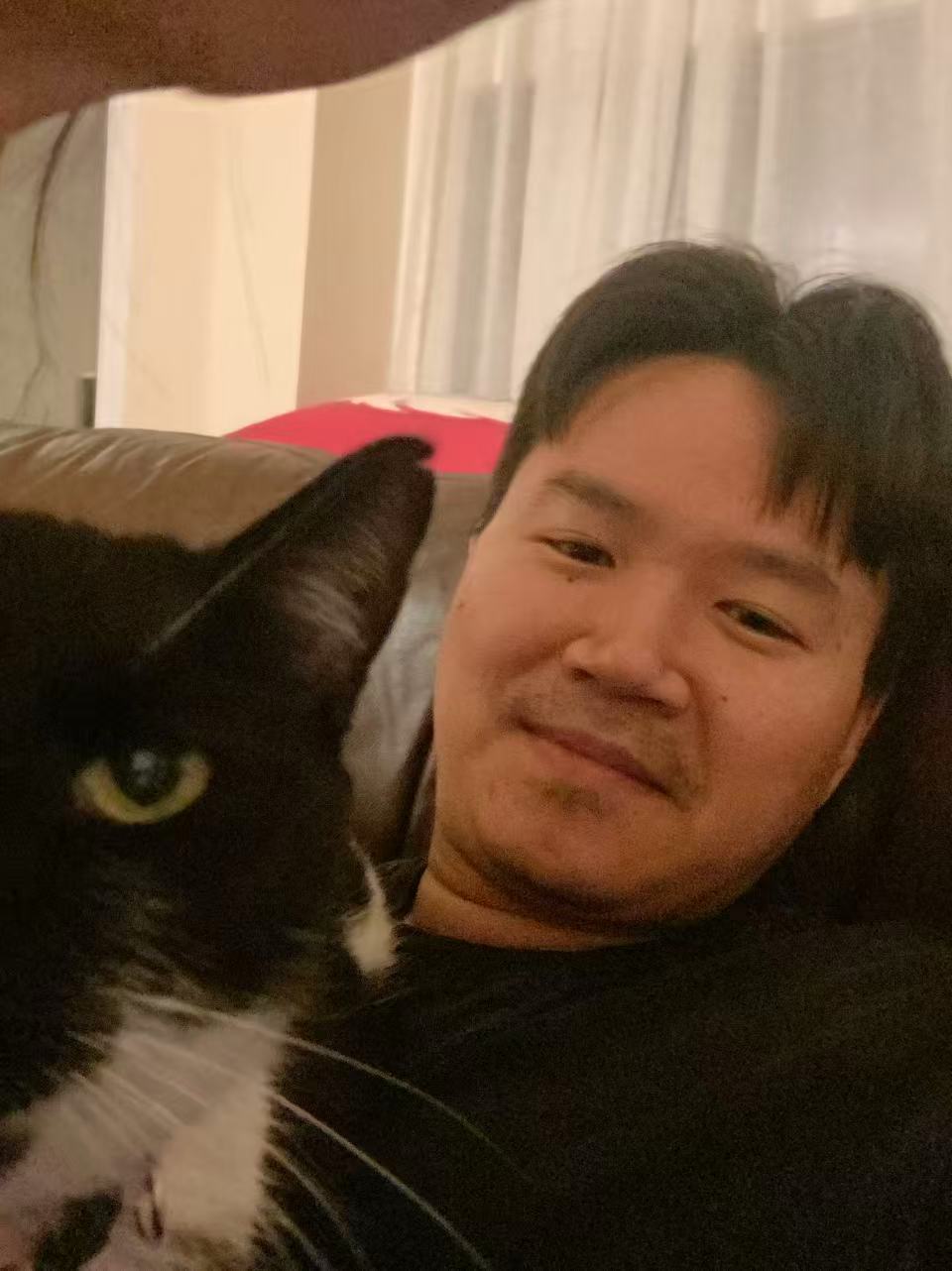
Shuofeng and Xiaobai the cat sharing a laptop

Xiaobai Conducts a Surprise Performance Review

My cat Xiaobai wedged himself between me and the keyboard tonight, declaring himself Chief Alignment Officer and demanding a comprehensive audit of treat-allocation fairness.

He batted at my laser pointer, added “meowtivation” slides to my deck, and insisted I replace every equation with a fishbone diagram “for clarity.”

Verdict: I’m cleared to pursue safe AGI, provided the model outputs at least one can of tuna per parameter update. I don’t remember approving that clause, but the pawprint signature seems legally binding.

Had dinner with the legendary Stephen Wolfram

A lovely dinner with Stephen Wolfram after he gave a talk at Oxford physics department, exchanging ideas about computation, physics, and the future of intelligence research.

Stephen believes the universe is determined, but that our presence on this planet is not—very much a compatibilist's view.

He also thinks hypergraph models are the ultimate answer.

We ate at Brown's. Thanks Prof. John Wheater for his invitation!

Blog

Random thoughts. Some might be useful.

A physicist who cares about the future of humanity, and AI

Meditates on Yang Chen-Ning's warning that "the party is over" for particle physics and follows the thread into AI, wondering whether intelligence research now carries the torch of curiosity that once belonged to colliders.

Read Prose →

How Large Language Models Like GPT‑5 Work: End‑to‑End Technical Overview

An end-to-end technical walkthrough of GPT‑5-scale language models, covering Transformer architecture, data pipelines, training and parallelism, alignment, inference/serving, and deployment safety with full references.

Read Prose →

Connect

I am open to collaborations, speaking engagements, and conversations about building thoughtful technology. Reach out via email or the channels below.